how-solestial-scaled-space-grade-solar-manufacturing-with-automation

How Solestial Scaled Space-Grade Solar Manufacturing with Automation

THE PROBLEM

Scaling Space-Stable Solar at Lower Production Costs 

Solestial is defining the future of space power as a provider of space-stable silicon photovoltaics. Their pioneering solar cells can self-heal from radiation damage, and deliver energy solutions in a flexible, low mass package at one-tenth of the conventional costs.

To realize their ambition of scaling from a one megawatt capacity facility to a 10-megawatt production capacity, Solestial recognized the necessity of moving from building modules completely by hand to utilizing automated equipment.

Additionally, the accelerated pace of production had to be balanced with more accurate simulations to de-risk the investment in automation.

Solestial needed a simulation-first automation platform to rapidly test and bring their ideas to life as well as an automation partner who could think creatively, and solve problems.
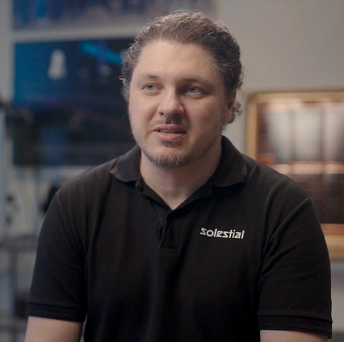
Stan Herasimenka, CTO, Solestial

“One thing that our team particularly liked about Vention is their ability to simulate the workflows, to actually test the equipment that they designed before it’s been built. We need Vention’s ecosystem to support us as we move forward with our product development.”—Stan Herasimenka, CTO, Solestial

THE PROJECT

Automating Multiple Custom Processes with Vention’s Platform

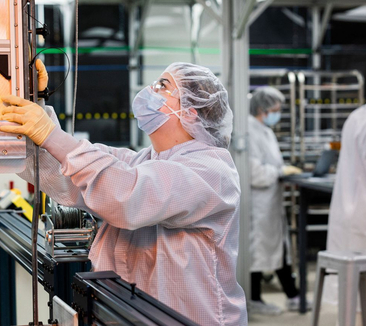
Solestial partnered with Vention to automate key steps in scaling production of its space-grade solar technology. The initial projects included automating wafer loading to increase throughput and reduce breakage, as well as automating wet-etch hoods used for processing wafers.

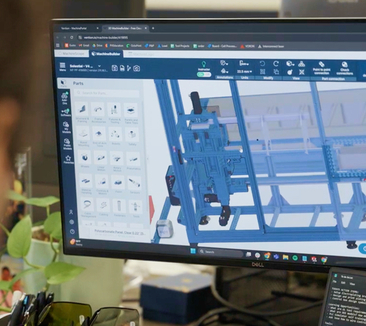
Using Vention’s intuitive MachineBuilder platform, Solestial collaborated closely with Vention engineers to design systems that integrated seamlessly with existing equipment. The digital design environment supported fast iteration, workflow visualization, and motion studies, which helped Solestial validate concepts and estimate throughput before committing to a build.

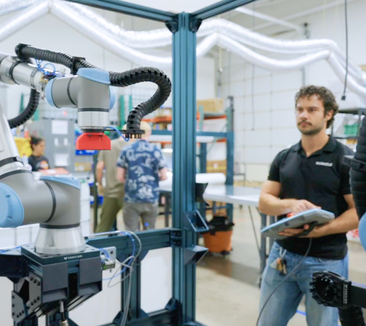
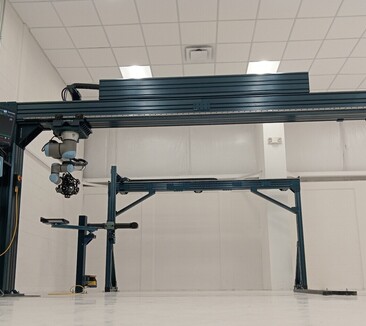
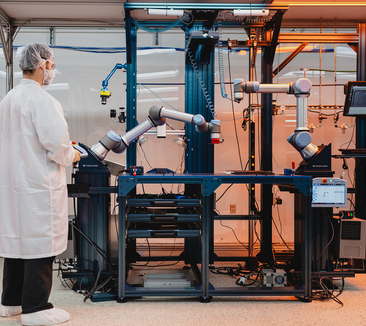
For the wafer-loading cell, Vention delivered a custom gantry system pre-assembled and ready for rapid installation, completing the project in four weeks. Dedicated engineering support helped Solestial deploy a precise pick-and-place solution for delicate wafer handling.

Vention also supported automation of Solestial’s long wet-etch hoods, which contain 12 to 16 tanks each. The team worked together to configure custom actuators and develop specialized enclosures tailored to the process requirements, helping bring a highly customized piece of equipment into automated production.
THE RESULTS

Building the Manufacturing Engine for Next-Generation Space Solar

Solestial’s partnership with Vention has delivered both immediate performance gains and long-term manufacturing advantage. The first key deployment of the automated wafer loading increased throughput by 50% while maintaining the precise handling required for ultra-thin wafers.

Automating with Vention also helped boost the deployment speed across all automation projects. For instance, the custom gantry system was shipped pre-assembled and installed in four weeks, helping Solestial scale production quickly to meet growing demand.

As Solestial expands its manufacturing capacity, automation is being evaluated through a long-term ROI lens. With Vention’s digital platform and simulation-first approach, Solestial can validate designs before purchasing equipment, enabling smarter capital planning and faster time to production.

Looking ahead, Vention’s collaborative engineering support, rapid design iteration, and hands-on deployment expertise will help Solestial bring new production processes online efficiently and build the manufacturing foundation required for large-scale, space-solar production.

3d-infotech-achieves-70-reduction-in-inspection-time-and-300-capacity-increase

3D Infotech Achieves 70% Reduction in Inspection Time and 300% Capacity Increase

THE PROBLEM

Solving Consistency and Throughput Challenges in High-Precision Quality Control

Quality Control (QC) is recognized as one of the most demanding applications in manufacturing, particularly when automated. Achieving consistency at scale is a significant challenge for any organization, as operators are expected to interpret complex blueprints, execute measurements within extremely tight tolerances, and maintain minimal variation.

To help their customers move beyond these constraints, 3D Infotech needed a high-accuracy, repeatable, and flexible inspection solution that could accommodate a wide variety of part geometries, detect visual and dimensional defects through machine vision and other sensors, operate reliably across multiple shifts, and be deployed far faster than traditional systems.

They also needed a platform that simplified fabrication, reduced the amount of custom engineering, and delivered a turnkey deployment experience measured in weeks rather than months.

THE PROJECT

From Concept to Deployment in Just Six Weeks

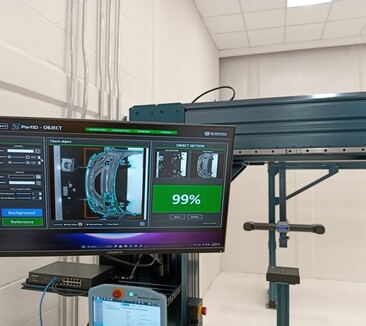
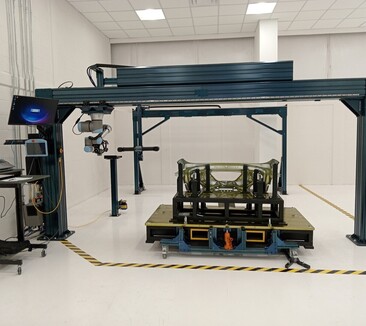
3D Infotech partnered with Vention to design and deploy a fully automated UMA Cell capable of high-precision scanning, GD&T reporting, dimensional deviation detection, and visual inspection across one, two, or three shifts.

Using Vention’s MachineBuilder platform, the team designed the complete system with drag-and-drop interface and the AI Design Assistant, accelerating design iteration by threefold. The digital environment enabled early virtual validation of reach, collision, and path feasibility.

Installation and programming were supported by Vention’s no-code MachineLogic interface, which allowed fast, interactive program creation. Simulation ensured the robot could access all required features before any hardware was fabricated.

Instant BOM creation and quoting helped compress the procurement phase, aligning with 3D Infotech’s goal of rapid deployment. The system shipped within a couple of weeks and reached full deployment two weeks after delivery. Its modular structure also enabled seamless updates and expansion after installation, allowing new components to be added without disruption.

Reduction in Inspection Time

THE RESULTS

70% Reduction in Inspection Time, Delivering 300% Throughput Increase

3D Infotech’s UMA Smart Cell delivered a measurable step-change in Quality Control performance. The team achieved a 70% reduction in scanning time, supported by the system’s ability to capture 6.0 million points per second with metrology-grade precision. Powered by 3D Infotech’s Streamline software, the solution ensures seamless coordination between hardware, automation, and data processing for maximum efficiency. For automotive sheet-metal manufacturers, this level of performance unlocks accuracy and repeatability that surpass traditional Coordinate Measuring Machines (CMMs).

By combining faster cycle times with fully automated workflows, inspection capacity increased by 300%, enabling customers to run more parts per shift with minimal operator involvement. The shift from manual interpretation to automated, repeatable workflows also contributed to a 50% reduction in scrap and rework, driven by earlier detection of dimensional deviations and higher-quality inspection data.

From an adoption point of view, the intuitive user experience meant operators required only one hour of training, reducing reliance on specialized metrology expertise while maintaining accuracy.

As 3D Infotech continues to scale its metrology automation offerings, the UMA Cell provides a repeatable blueprint for rapid deployment, modular expansion, and metrology-grade performance across a wide range of manufacturing environments.